Animal Farm
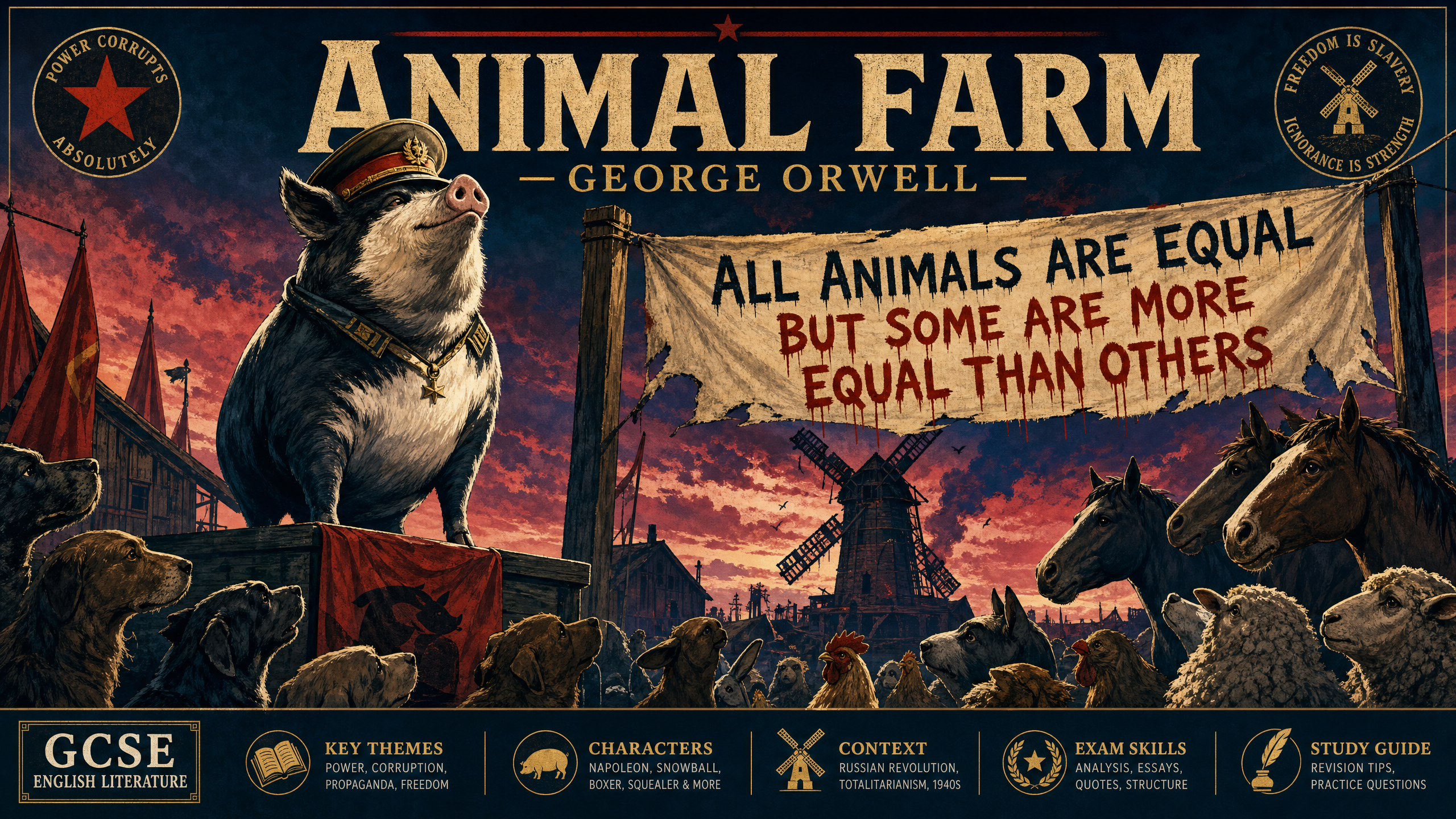
Animal Farm is George Orwell's devastating political allegory exploring how revolutionary ideals are corrupted by power. Studying this text rewards candidates who can analyse the shift from equality to tyranny, and who can seamlessly integrate the historical context of the Russian Revolution into their arguments.
Study Notes
Overview
George Orwell's 'Animal Farm' (1945) is a brilliant, multi-layered novella that functions simultaneously as a beast fable and a sharp political allegory. Examiners are looking for candidates who can navigate both levels: exploring how Orwell presents the farm animals' struggles while analysing how these characters represent key figures and concepts from the Russian Revolution and Stalinist Russia. High marks are awarded to those who can analyse Orwell's use of language—particularly Squealer's propaganda—and structure, charting the tragic decline from the hopeful ideals of 'Animalism' to a totalitarian regime where 'some animals are more equal than others'.
Listen to our 10-minute revision podcast covering core concepts, key quotes, and examiner tips!
Plot/Content Overview
- Chapter 1: Old Major shares his dream of a world without human oppression and teaches the animals 'Beasts of England'.
- Chapter 2: Old Major dies. The animals rebel, expel Mr Jones, and establish the Seven Commandments of Animalism.
- Chapters 3-4: The farm prospers initially. Snowball and Napoleon emerge as rival leaders. The animals successfully defend the farm in the Battle of the Cowshed.
- Chapter 5: The rivalry peaks over the windmill. Napoleon uses his secret guard dogs to expel Snowball and seizes total control.
- Chapters 6-7: Life becomes harder. The windmill is destroyed and Snowball is scapegoated. Napoleon stages brutal show trials and executions.
- Chapters 8-9: The pigs rewrite history and the Commandments. Boxer is worked to exhaustion and treacherously sold to the knacker's yard.
- Chapter 10: Years later, the pigs walk on two legs and wear clothes. The final Commandment is corrupted. The animals look from pig to man and cannot tell them apart.
Themes
Theme 1: The Corruption of Power
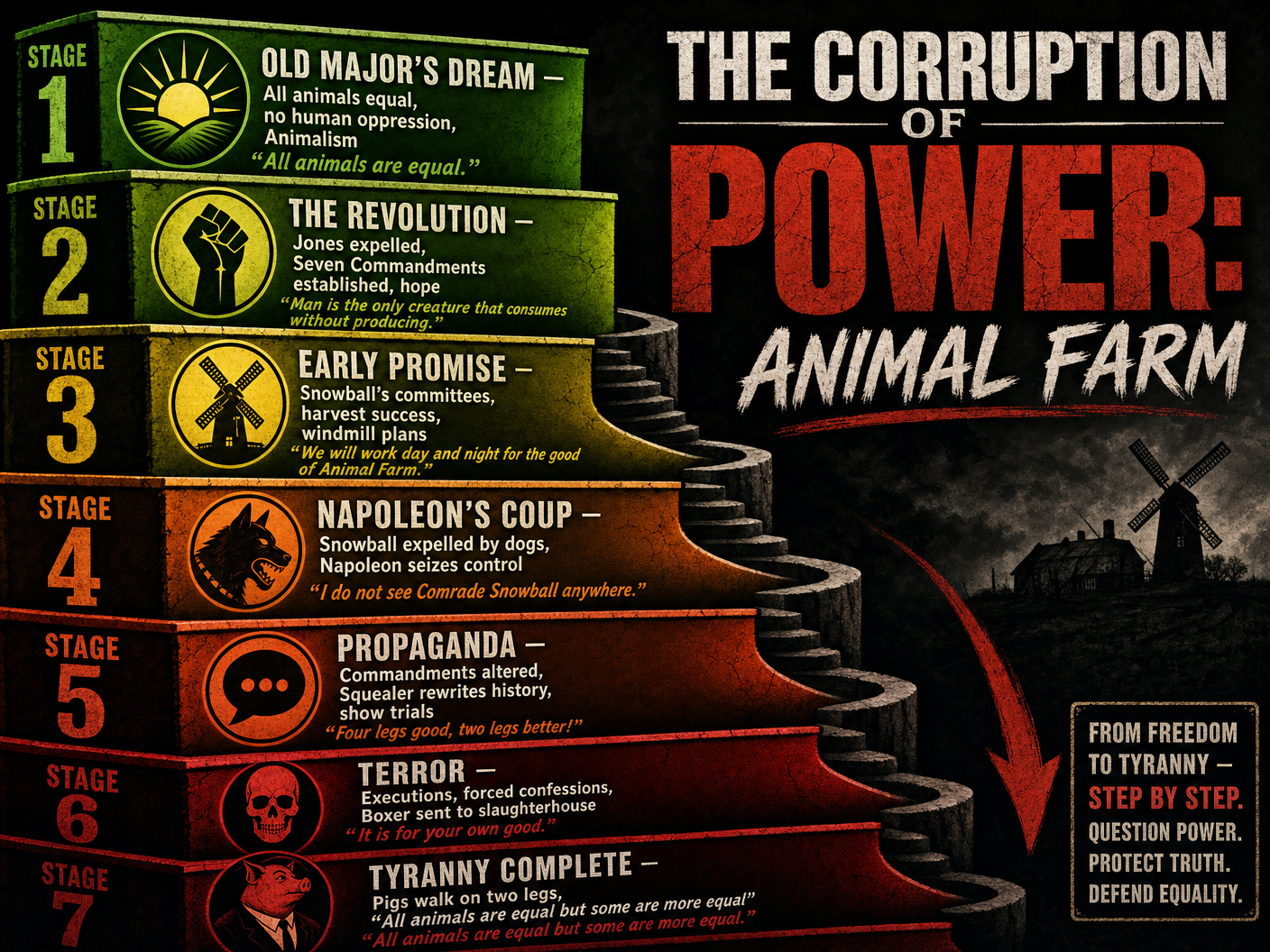
Orwell explores how absolute power corrupts those who wield it. The pigs begin as liberators but gradually adopt the very behaviours they overthrew. This theme develops structurally: early chapters show democratic committees, while later chapters show dictatorial decrees and violence.
Key Quotes:
- "All animals are equal, but some animals are more equal than others." (Chapter 10) - The ultimate expression of corrupted power, using paradox to highlight the hypocrisy of the regime.
- "Napoleon is always right." (Chapter 5) - Boxer's maxim demonstrates how absolute power relies on the blind obedience of the masses.
Theme 2: Propaganda and Manipulation of Truth
Language is presented as an instrument of control. Squealer constantly revises history and alters the Seven Commandments to justify the pigs' privileges, demonstrating how totalitarian regimes gaslight their citizens.
Key Quotes:
- "Four legs good, two legs better!" (Chapter 10) - The ultimate corruption of the original maxim, showing how language can be completely inverted.
- "Squealer could turn black into white." (Chapter 2) - A metaphor establishing Squealer's role as the manipulator of truth.
Character Analysis
Napoleon
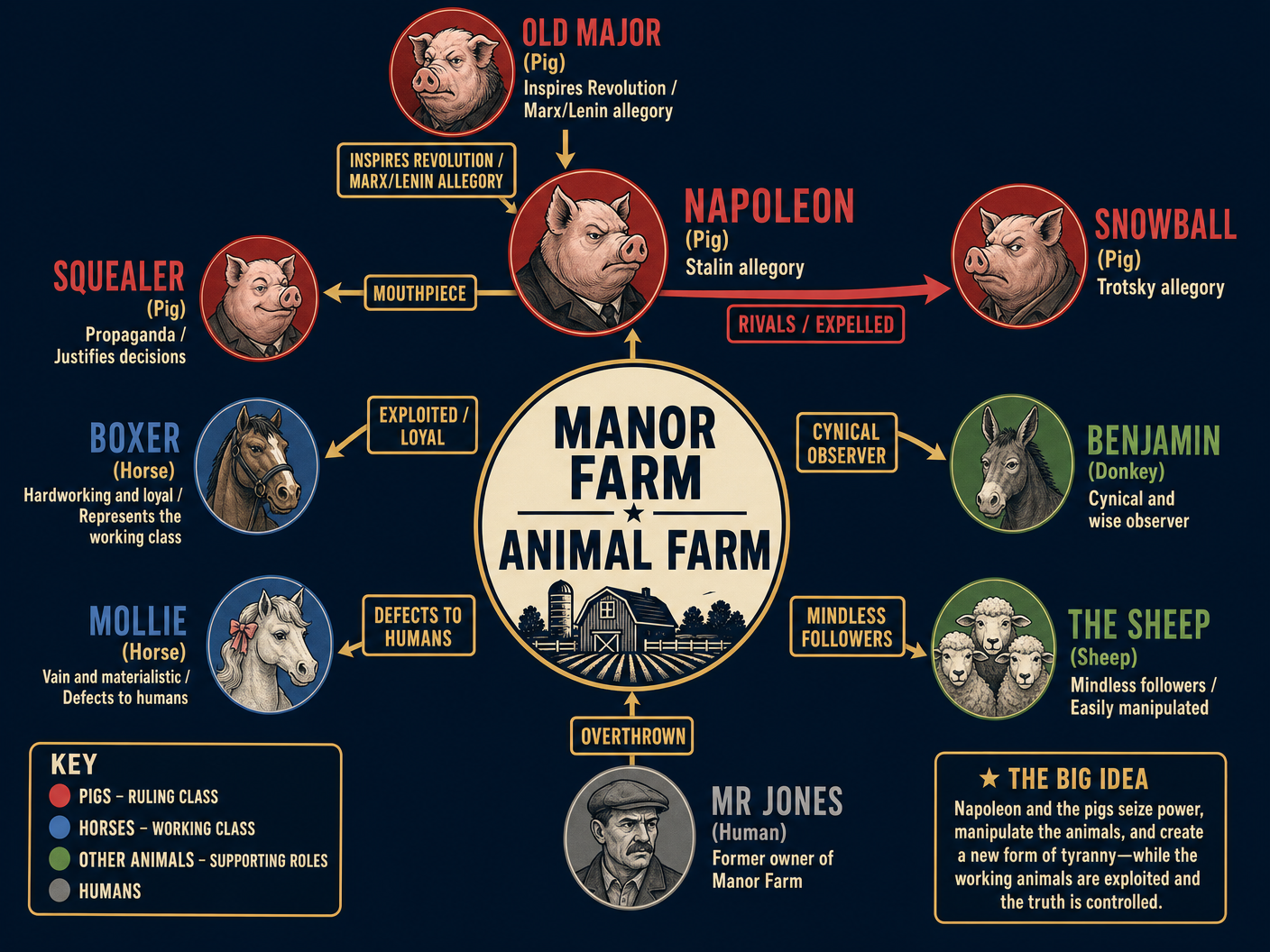
Role: The antagonist; represents Joseph Stalin and totalitarian dictators generally.
Key Traits: Cunning, ruthless, patient, self-serving.
Character Arc: Transforms from a quiet but forceful rebel into a paranoid, violent, human-like tyrant.
Essential Quotes:
- "Napoleon, with the dogs following him, now mounted on to the raised portion of the floor..." (Chapter 5)
- "There was only one candidate, Napoleon, who was elected unanimously." (Chapter 9)
Snowball
Role: Napoleon's rival; represents Leon Trotsky.
Key Traits: Intelligent, idealistic, eloquent, innovative.
Character Arc: Leads the farm successfully but is outmanoeuvred by Napoleon's brute force and subsequently used as a permanent scapegoat.
Essential Quotes:
- "Snowball was a more vivacious pig than Napoleon, quicker in speech and more inventive..." (Chapter 2)
- "Whenever anything went wrong it became usual to attribute it to Snowball." (Chapter 7)
Boxer
Role: The loyal, hardworking cart-horse; represents the dedicated, exploited working class (the proletariat).
Key Traits: Strong, loyal, uncomplaining, intellectually limited.
Character Arc: Works himself to the point of collapse for the farm, only to be betrayed and sold for profit by the pigs.
Essential Quotes:
- "I will work harder." (Chapter 3)
- "His two slogans... seemed to him a sufficient answer to all problems." (Chapter 6)
Squealer
Role: Napoleon's mouthpiece; represents the Soviet propaganda machine (e.g., Pravda).
Key Traits: Persuasive, deceptive, manipulative.
Character Arc: Progressively alters the truth until the animals' memories are completely erased.
Essential Quotes:
- "Day and night we are watching over your welfare. It is for YOUR sake that we drink that milk and eat those apples." (Chapter 3)
Writer's Methods
Orwell uses the beast fable form to make his political critique accessible and universal. The use of an omniscient third-person narrator who adopts the naive perspective of the animals creates powerful dramatic irony—the reader understands the pigs' corruption long before the other animals do. The cyclical structure of the novella (ending where it began, with animals oppressed by their masters) reinforces the pessimistic message about revolution.
Context
Examiners expect candidates to link the text to the Russian Revolution of 1917 and the subsequent rise of Stalinism. However, Orwell subtitled the book 'A Fairy Story' to indicate that its themes are universal. It is a critique of totalitarianism in all its forms. Context should be integrated into analysis of character and method—for example, linking Squealer's changing of the commandments to the Soviet practice of altering photographs and rewriting history.
Visual Resources
2 diagrams and illustrations
Interactive Diagrams
1 interactive diagram to visualise key concepts
Conceptual Flow Outline
The Structural Decline of the Revolution
Worked Examples
2 detailed examples with solutions and examiner commentary
Practice Questions
Test your understanding — click to reveal model answers
How does Orwell use the character of Boxer to explore the theme of exploitation?
Hint: Consider Boxer's maxims, his physical strength versus his intellect, and his ultimate fate at the knacker's yard.
Explore the significance of the windmill in Animal Farm.
Hint: Think about what the windmill represents initially (progress) versus what it becomes (a tool for exhaustion and control).
How does Orwell present the relationship between humans and pigs in the novella?
Hint: Look at the beginning (rebellion against humans), the middle (trading with humans), and the end (becoming indistinguishable from humans).
Starting with the extract where Old Major gives his speech, explore how Orwell presents ideas about rebellion.
Hint: Contrast the idealism of Old Major's speech with the reality of how the rebellion turns out.